
The STK wineries from Styria
Over 15 years ago, 12 ambitious winemakers joined forces to promote the diversity of Styrian wine on the international stage.

Our most popular STK wines




The wine region of Styria
Styria – Austria's green heart – is known not only for its picturesque landscapes, pumpkin seed oil, and apple strudel, but also for its traditional winemaking culture of the highest quality. Since 2010, twelve visionary winemakers from Austria's southernmost wine region have joined forces to highlight the unique vineyard sites and grape varieties of Southern Styria. Their goal: to create world-class wines that express the terroir in its purest form .


From top left to bottom right: Kapfenstein Castle with the adjacent Kirchleithen vineyard in the volcanic region (©Winkler-Hermaden), Sulz vineyard near the Slovenian border (©Tement), winemaker Hannes Sabathi in the company's barrique cellar near Gamlitz (©Hannes Sabathi), Josef and Maria Gross on the Nussberg (©Gross)
What makes Styrian wine special
The combination of extremely steep slopes, barren soils, and a climate that fluctuates between alpine freshness and Pannonian warmth characterizes Styrian wine. Here, where the vines can often only be tended by hand, wines of breathtaking precision, minerality, and depth are produced.
Between the Alpine region and Pannonia
Styria lies at the crossroads of two climate zones: While cool Alpine winds blow from the west , the east brings Pannonian dryness and warmth . These contrasts shape the character of the wines: Western Styria is defined by highly mineral wines with steely acidity, in Southern Styria the additional Adriatic influence provides strong acidity with vibrant aromas, and further east in the volcanic region, wines with somewhat milder acidity and more dominant spice are produced, already hinting at a proximity to the Pannonian Basin.
In western and southern Styria, soils with limestone, slate, and gravel content predominate, lending the wines elegant minerality and firm acidity . In the volcanic region, on the other hand, volcanic soils with basalt and tuff provide spicy depth and powerful structure .
Steep slopes, hard work
The vineyards cling to steep slopes with gradients of up to 70%. Machines often have no chance here. Most Styrian vines are therefore harvested by hand, with each grape individually selected during the harvest. And this painstaking work is worthwhile: the extreme locations produce concentrated aromas, vibrant acidity, and a mineral depth that makes Styrian wines unmistakable. The prevailing principle is usually "less is more" —spontaneous fermentation, extended lees aging, and minimal intervention produce decidedly terroir-driven, aromatic wines.
World-class white wine
Styria is clearly a white wine region. Sauvignon Blanc, in particular, unfolds its full potential in the cooler, wetter regions. The wines shine with aromas of gooseberry, elderflower, and an electrifying minerality reminiscent of damp stone.
In addition, the Morillon (Chardonnay) in particular shows what the Styrian soils are capable of: In the best locations, the Burgundy variety ripens into complex wines with notes of ripe apples, hazelnut and a hint of butter caramel.
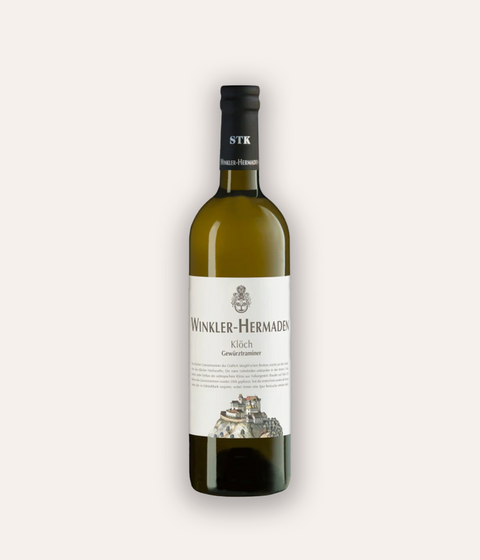
Several other white wine varieties also thrive in the region: Pinot Blanc with floral and nutty notes, Pinot Gris with a creamy texture, and Yellow Muscat with intense elderflower and tropical aromas. Riesling and Welschriesling also find ideal conditions here, as does Gewürztraminer , which flourishes particularly well in Klöch in southeastern Styria. Also worth mentioning is the western Styrian Schilcher – a rosé made from the Blauer Wildbacher grape variety, which causes a sensation every year, especially as a young wine, and is a must-have at every Styrian autumn festival.
The STK quality levels
Inspired by international models such as the AOP or VDP systems, STK winegrowers follow a three-tier quality hierarchy :
- Regional wines are varietal entry-level wines that reflect the diversity of Styria. They are ideal for casual wine lovers.
- Village wines clearly emphasize their origin from specific municipalities and therefore exhibit a stronger terroir character. The differences are easily recognizable even to novices, making them ideal wines for rum tasting.
- Single-vineyard wines (1STK & GSTK) : The top class. 1STK stands for Erste Lage (Premier Cru) vineyards with pronounced terroir, while GSTK (Große STK) designates the absolute top sites. These wines have a high concentration of aromas, great complexity, and usually excellent aging potential.
All STK winegrowers must adhere to the strict guidelines of the respective classification – from the choice of grape varieties, through hand harvesting and spontaneous fermentation to the specified ripening period.

The quality levels of the STK wineries (©www.stk-wein.at)
Our STK recommendation
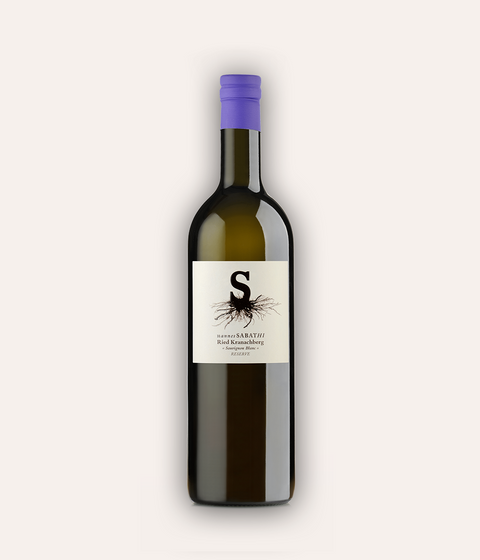
Hannes Sabathi – Sauvignon blanc Ried Kranachberg Reserve 2019
Austria → Styria → Southern Styria DAC
99.33 €/l | Price incl. VAT | plus shipping costs


